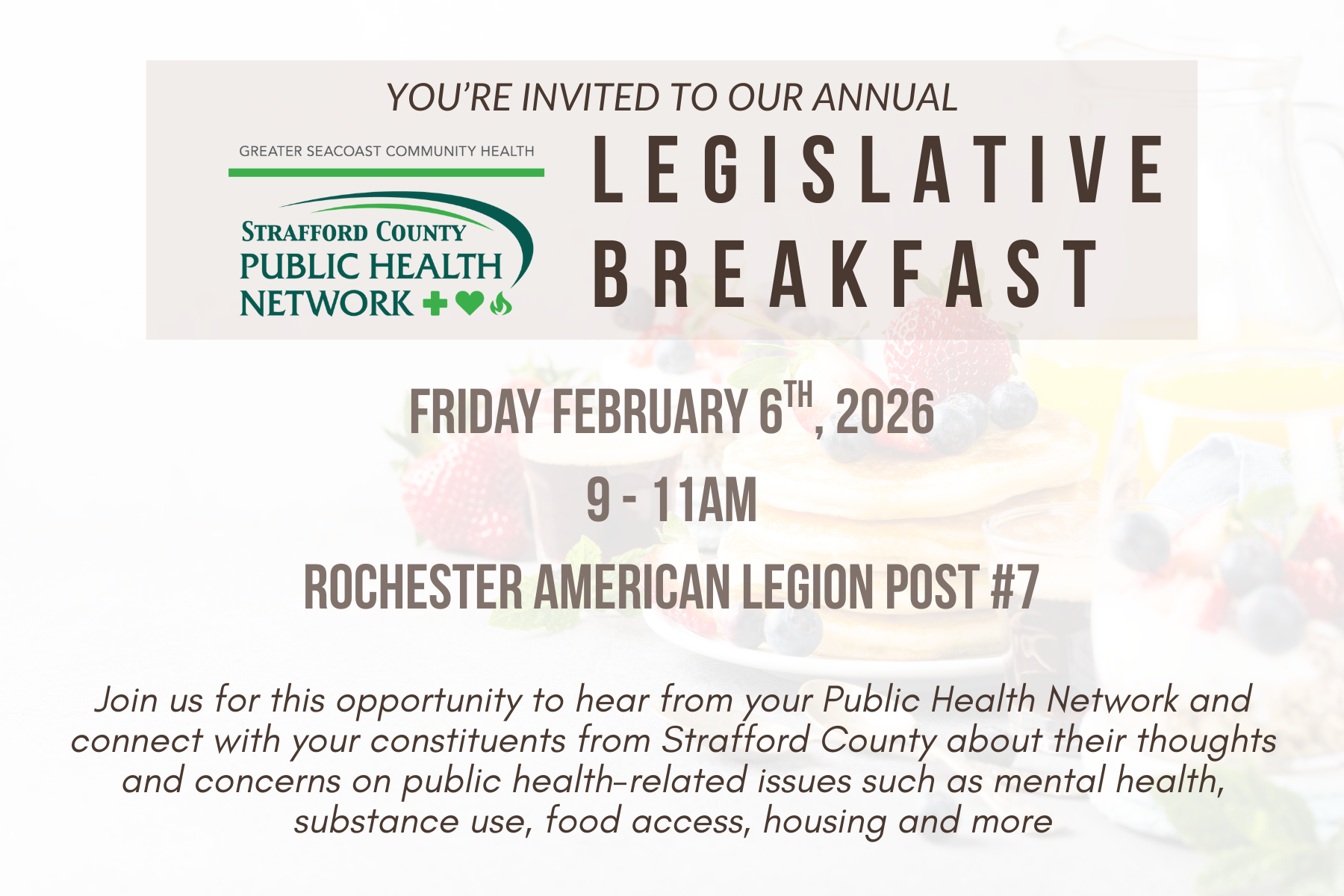
Each year, SCPHN alongside many of our partners and fellow advocates, host our annual Legislative Breakfast to draw attention to our legislative priorities. The Breakfast draws community members, partners, as well as state and local legislators to learn more and join in discussion about some of the challenges facing our communities and how legislative action may impact those challenges for better or for worse.
These events are free and open to anyone interested in these issues in the Strafford County community.
Our 2026 Legislative Breakfast has been scheduled for Friday February 6th at the Rochester American Legion. We hope you'll join us!
Our advocacy work is supported by the NH Charitable Foundation, in partnership with New Futures.
MORE DETAILS FOR THIS YEAR'S EVENT COMING SOON!
2025 Areas of Focus & Calls to Action
See below for resources, reference sheets & reports related to our areas of focus.
Data & Insights
-
- Strafford County has a mental health-to- provider ratio of 300:1, the 2nd highest in NH
- 39.6% of Strafford County High School students felt sad or hopeless almost every day for 2 or more weeks in a row and stopped doing some usual activities in the past 12 months (2023 YRBS)
- 42.5% of Strafford County High School students never or rarely got help they needed when they felt sad, empty, hopeless, angry or anxious (2023 YRBS)
- 21.3% of Strafford County High School students have seriously considered attempting suicide in the past 12 months (2023 YRBS)
- In our Community Advocacy Survey, a lack of treatment providers and adequate resources was the most noted challenge in Strafford County related to mental health and/or substance use, with many mentioning difficulty navigating the system or finding providers that will take their insurance, including Medicaid
- 1 in 3 NH adults covered by Medicaid expansion access mental health care (over 25,000 people) or substance use disorder treatment (nearly 7,500 people) (NH Needs Medicaid Coalition)
- 221,000 adults in New Hampshire have a mental health condition
- In New Hampshire, 57,000 adults have a serious mental illness
- In February 2021, 37.7% of adults in New Hampshire reported symptoms of anxiety or depression. 17% were unable to get needed counseling or therapy
- Of the 70,000 adults in New Hampshire who did not receive needed mental health care, 41.7% did not because of cost
- 92,510 people in New Hampshire live in a community that does not have enough mental health professionals
- 15,000 Granite Staters age 12–17 have depression
- 56.6% of Granite Staters age 12–17 who have depression did not receive any care in the last year
Calls to Action
-
- Support NH's Investment in the Alcohol Fund: The 5% investment of gross alcohol sales supports local prevention, treatment, and recovery programs such as student assistance programs, recovery centers and family support services. These programs are part of the critical infrastructure to strengthen collective efforts to prevent and address substance use related challenges in our communities.
- Invest in Local Programs and Efforts to Expand Access: In addition to workforce development, barriers to accessing mental and behavioral healthcare include transportation, insurance, stigma, and the availability of services to treat co-occurring disorders (in other words, that treat mental health and substance use disorders together). Many community stakeholders are working to find collaborative solutions to break down these barriers. Investment in these efforts at both the state and local level will help solve systematic and environmental inefficiencies that are keeping people from accessing resources and services.
Data & Insights
Housing Prices Outpace Median Income & Avg. Wages in NH
2019 - 2023 Increases:
Median Price of a Single Family House: 56.7%
Median Price of a 2-Bedroom Rental Unit: 31.0%
Median Household Income: 24.3%
Average Private Sector Hourly Wages: 26.7%
Source via NH Fiscal Policy Institute Presentation: NH Realtors; U.S Census Bureau, American Community Survey, 2019-2023 1-yr Estimates; NH Employment Security, Granite Stats, Private Sector Hourly Wage; NH Housing, 2024 Residential Rental Cost Survey Report
-
- 52.1% increase from 2022 to 2023 in the number of people experiencing homelessness during the NH January Point in Time Count. National PIT Count increased only 12%.
- The total number of individuals who experienced homelessness in NH in calendar year 2023 was 6,806 - which is larger than the population of 80% of NH municipalities
- A balanced and healthy rental market should have a vacancy rate of 5% to 6%
- In 2023, the average vacancy rate in Strafford County for a 2 bedroom unit was 0.06%
- Nowhere in NH has a vacancy rate above 1% at this time
- New Hampshire has not seen a vacancy rate at or above 5% since 2009
- As of June 2023, costs for a single-family home in NH reached a median sales price of $499,000, an increase of 50.9% from June 2020
- For housing to qualify as "affordable," expenses like rent and utilities for renters, and mortgage, property taxes, and insurance for homeowners shouldn't surpass 30% of a household's gross annual income - Anything beyond that is considered cost burdened
- 31% of homeowners and 44% of renters are considered cost burdened in Strafford County
- 27% of households are low-income in Strafford County
- The Consumer Price Index (CPI) in New England has increased by 7.4% from Sept 2021 to Sept 2022 with the highest increases in gas, shelter, and food (target inflation rate is 2% per year
-
- As New Hampshire's population ages and property values continue to rise, many seniors on fixed incomes—who may also face health challenges or disabilities—are finding it increasingly difficult to maintain ownership of their homes. With the availability of affordable and senior housing remaining limited, more and more older residents are experiencing housing insecurity and homelessness for the first time. It’s essential that we create more affordable housing solutions to ensure our seniors can age with dignity and stability, and remain part of the communities they’ve helped build.
- As the housing crisis gains more attention, new coalitions are emerging to bring together key stakeholders and foster creative solutions, with increased leadership at the state level. One such example is the NH Housing Supply Coalition, formed by the Business & Industry Association, Housing Action NH, NH Home Builders Association, and the NH Association of Realtors. Their shared message is clear: “The growth and competitiveness of New Hampshire’s economy depend on the availability of a dynamic and skilled workforce. The most significant barrier to attracting and retaining the workforce the state’s economy needs is the supply and affordability of housing.” This coalition highlights the critical connection between housing affordability and the future of New Hampshire's economy, urging a collaborative approach to solving this issue.
Calls to Action
- Support Affordable Housing Development at the State level & In Your Community: This can include zoning, regulation, expanding access to different types of housing including Recovery Homes,
- Fund Programs that Support Housing Access in Our Community: This can include programs like Housing Champions, Housing Choice Vouchers, Rapid Rehousing, and other programs that help people experiencing housing instability or homelessness find housing options that meet their needs.
- Work with Local Stakeholders and Coalitions to Develop Bi-Partisan Supported Housing Policy: Engagement across the community, collaboration and connection are necessary to create solutions that are supported across the aisle.
Data & Insights
-
- In NH 39% of children, 31% of adults and 27% of older adults lived in homes reporting insufficient food (US Census Pulse September 2024)
-
- 1 in every 3 NH adults reported it was somewhat or very difficult to afford regular household expenses, including food, car payments, rent or mortgage (US Census Bureau Survey between Jan-Oct 2023)
-
- NH is 47th out of the 50 states in school breakfast participation ranking.
- Only 46% of children who participate in free breakfast eat breakfast
- Only 33% of eligible people in Strafford County are enrolled in SNAP.
- Only 54% of eligible people in NH are enrolled in the WIC Program for supplemental food.
- 15.5% of Strafford County High School students reported going hungry because there was not enough food in the home
- In Strafford county, the average cost of a meal is $3.64 and the SNAP benefit per meal is $2.83
- One theme from our Community Advocacy Survey included a notable increase in people accessing resources such as food pantries to supplement their groceries. Several noted that more are relying on these services and many present with more needs than they’re able to address such as housing, medical needs, mental health and substance use challenges
Calls to Action
-
- Support Policy that Makes it Easier for People to Access Services: Programs like Free and Reduced Meals and SNAP have complicated enrollment processes that often keep people from signing up even when they need help. Supporting policies that make it easier for people to enroll in programs removes administrative barriers, reduces stigma and helps connect people to programs and food for themselves, their children and their families.
- Connect with Local People to Hear their Stories: Visit a food pantry, community center, or school cafeteria to see firsthand the challenges of food insecurity and the impact of support programs. Hearing directly from those affected will help you make informed policy decisions that better serve your constituents. These visits also offer valuable insight into how policies play out on the ground, highlighting both successes and areas for improvement.
- Champion Community-Driven Solutions: Support funding and policies that empower local organizations—like farm-to-school programs and community food initiatives. These efforts create sustainable, place-based solutions that strengthen local food systems and reduce hunger.
Data & Insights
-
- “...using passive consent procedures...typically result in a very high response rate, and may also yield a nonbiased sample for population-based surveys (e.g., all of the enrolled students at a school). [In the 1st year of a study (Pokorny, et al. 2001) parent consent letters were sent to over 7,000 6th – 8th graders, giving parents the opportunity to decline permission .. The participation rate was 89% and representative of the enrolled students.]”
- Some studies show that active consent procedures can result in a biased sample, which affects your ability to generalize the results. (Liu et al., 2017) (Spence et al., 2015)
- It is important for us to understand the attitudes, perceptions and behaviors of youth in our communities. The YRBS gives schools, policy makers, coalitions, and our communities data to identify problems, develop and evaluate strategies to create positive change.
- One of the major criticisms of using passive consent procedures is that the parent/guardian may not get the information they need about the study. Current laws mitigate that risk with policies and procedures regarding the timing and process of notification of parents/guardians of the survey and the ability to opt-out of the survey.
- While it is possible to elicit high participation rates with active consent, more resources are often needed to accomplish this goal, and you might exclude those at highest risk.
Call to Action
It is important for us to know what is going on in the life of NH's adolescents. The Youth Risk Behavior Survey (YRBS) asks about student's attitudes, perceptions and behaviors about a number of topics including health, diet, substance use, mental health, sexual health, safety and more. The YRBS is a key tool that informs how our schools, organizations and communities support young people. The data is used to create and evaluate programs and messaging, and to evaluate whether those strategies are working. Support the implementation of the YRBS and the practices that maintain the integrity of the data collected.
Insights & Data
Over 187,000 NH citizens (about 13% of the population) are enrolled in Medicaid, nearly half of which are children (NH Needs Medicaid Coalition)
Since the start of Medicaid Expansion:
-
- 63% reduction in the number of uninsured patients seeking emergency care
- 57% drop in uninsured patient admissions
- 41% reduction in uninsured outpatient admissions
- uncompensated care attributable to uninsured patients plummeted from $173 million in 2014 to $69 million in 2021
A publication by the US Department of Health and Human Services states that studies show Medicaid work requirements “reduce enrollment in health coverage, limit access to care, and do not increase employment.”
NH’s healthcare workforce shortages are keeping people from accessing the care they need in a timely manner, negatively impacting the health and wellbeing of individuals, families, and our communities
In a 2023 Issue Brief, NH Fiscal Policy Institute highlighted housing and child care availability and costs in NH are limiting growth in our workforce
The NH Vaccine Association (NHVA) supports the Universal Purchase Program, which ensures that every child who enters a healthcare setting can receive recommended vaccines at no cost. This process has removed barriers for providers and, as a result, NH has one of the highest vaccination rates in the US. (NH Vaccine Association FY2024 Report)
Calls to Action
-
- Invest in Workforce Development: Staff shortages are a key factor limiting access to care across the healthcare industry - including Community Health Workers (CHWs), nurses, oral health providers and more. Investing in workforce development initiatives will help recruit new people to the field, retain existing healthcare providers, and improve availability and quality of care for Granite Staters.
- Keep People Covered: Data shows that insurance coverage markedly improves people’s ability to access healthcare services, ultimately preventing disease and leading to better health outcomes. It also shows that barriers like work requirements put nearly 1 in 4 of our most vulnerable populations at risk of losing coverage. (US Dept. of Health and Human Services)
- Maintain the NH Vaccine Association to Keep NH Kids Healthy: The NH Vaccine Association (NHVA) is a key component of our state’s ability to fight vaccine-preventable disease in our youngest Granite Staters. The removal of the NHVA will increase costs for both families and providers, making vaccines harder to get.
2025 Legislation
The pieces of legislation in this list section relate to the three priority topics from our Legislative Breakfast. As you consider these bills, and others like them, we ask that you keep in mind the information referenced on this page, and the stories our panelists and speakers share.
Support NH's investment in the Alcohol Fund in the State Budget! The Alcohol Fund directs 5% of profits of alcohol sales to substance use disorder prevention, treatment, and recovery programs in NH communities. Click here to take action to support the Alcohol Fund!
SB255 establishing and developing crisis stabilization services, provides a fiscally responsible way to support the 988 Suicide Crisis Lifeline in NH (Click here to take action to SUPPORT this bill)
SB128 relative to children's mental health services for persons 18 years of age and younger, would require private insurers to help fund access to behavioral health wraparound services, increasing access to care for all children and removing the tax burden from Granite Staters (Click here to take action to SUPPORT this bill)
HB751 requiring licensure of outpatient substance use disorder treatment facilities and relative to complaint investigation of treatment facilities by the department of health and human services office of the ombudsman and making an appropriation therefor. This bill aims to improve the quality of care and protect patients in our substance use treatment systems. (Click here to take action to SUPPORT this bill and to learn more about the changes proposed)
HB432 relative to recovery houses, would provide NH's cities and towns with clear guidance around zoning and fire regulations for Recovery Housing, which would provide opportunity to expand access to this critical resource for our neighbors in recovery. (Click here to take action to SUPPORT this bill)
HB226 relative to the use of drug checking equipment, would help prevent overdoses by making it legal to possess and use drug testing equipment. (Click here to take action to SUPPORT this bill)
HB60 relative to the termination of tenancy at the expiration of the tenancy or lease term, aims to remove existing tenant protections and put all Granite State renters at increased risk of eviction, especially older adults and people with disabilities who already face significant housing challenges. (Click here to take action to OPPOSE this bill)
HB432 relative to recovery houses, would provide NH's cities and towns with clear guidance around zoning and fire regulations for Recovery Housing, which would provide opportunity to expand access to this critical resource for our neighbors in recovery. (Click here to take action to SUPPORT this bill)
SB204 relative to the responsibility of local school districts to provide meals to students during school hours, reimbursing schools for meals provided to students at no cost, and making an appropriation therefor, would increase eligibility for free schools meals to 200% FPL (Click here to take action to SUPPORT this bill)
HB583relative to state participation in the Medicaid direct certification program for free and reduced price school meals, would automatically enroll children in Free/Reduced-Price meals who are on Medicaid and whose family's income qualifies them for school meals, without another application (Click here to take action to SUPPORT this bill)
HB319 relative to the responsibility of local school districts to provide transportation for pupils in kindergarten would remove schools’ responsibility to provide a meal for half-day kindergarten students, taking nutritious meals away from some of our youngest learners (Click here to take action to OPPOSE this bill)
- HB446 Amendment 42h: we OPPOSE Amendment 42h that aims to create an opt-in process for participation in the Youth Risk Behavior Survey (YRBS) (Click here to take action to OPPOSE this bill!)

HB524 repealing the New Hampshire vaccine association, would remove NH's current process for purchasing vaccines that can be provided to children at no-cost, which allows for more access. By removing this system, families will likely have to pay co-pays and fees, and we will see a decrease in vaccine uptake for preventable diseases, which will increase rates of disease in our communities. (Click here to take action to OPPOSE this bill)
HB377 relative to health care professionals administering hormone treatments and puberty blockers would prevent Granite State youth from receiving evidence-based, medically necessary care that research shows can benefit the mental health and well-being of transgender youth. Gender-affirming care has been endorsed by leading U.S. medical authorities like the American Academy of Pediatrics1 and American Medical Association2 . Medical decisions like this should be left to families and doctors, not politicians. (Click here to take action to OPPOSE this bill)
SB122 relative to financial eligibility for the Medicare savings program, aims to expand eligibility for NH's Medicare Savings Programs, allowing more older adults to be eligible and receive benefits, and expand access to care. (Click here to take action to SUPPORT this bill)
SB244 relative to expanding access to primary health care services, increasing the size of the health care workforce, and making appropriations therefor, would help to grow NH's healthcare workforce by supporting key investments for recruitment, training and retention. (Click here to take action to SUPPORT this bill)
SB134 relative to work requirements under the state Medicaid program, which would impact those most vulnerable, keeping them from receiving coverage and complicating their ability to access care. (Click here to take action to OPPOSE this bill)
SB96 relative to mandatory disclosure by school district employees to parents, would require teachers to "out" students to their parents, which would discourage young people from finding support that is critical to their well-being, especially when they may not feel safe talking to their families. (Click here to take action to OPPOSE this bill)
HB357 relative to the department of health and human services' rulemaking authority regarding immunization requirements. (Click here to take action to OPPOSE this bill)
HB358 relative to exemption from immunization requirements on the basis of religious belief. (Click here to take action to OPPOSE this bill)
Supporting Documents & Resources (2025):
- Supporting the YRBS (SCPHN 1-Pager)
- NH's Growing and Changing Population Since the Pandemic (NH Fiscal Policy Institute Issue Brief)
- Who is Experiencing Poverty in NH (NH Fiscal Policy Institute Issue Brief)
- Living Expenses, Financial Vulnerability and Poverty in NH (NH Fiscal Policy Institute Issue Brief)
- Health in NH (NH Fiscal Policy Institute Fact Sheet)
- Support the Alcohol Fund (New Futures Fact Sheet)
- Investing in the Healthcare Workforce (New Futures Fact Sheet)
- Increasing Access to Behavioral Health Wraparound Services for Children (New Futures Fact Sheet)
- Strengthening Crisis Care in NH: Supporting 988 (New Futures Fact Sheet)
- Protecting NH's Substance Use Treatment System (New Futures Fact Sheet)
- Housing in NH: Shortages Raising Costs (NH Fiscal Policy Institute Fact Sheet)
- Poverty & Food Insecurity After the COVID-19 Pandemic (NH Fiscal Policy Institute Issue Brief)
- Trends in Food Insecurity in NH (NH Fiscal Policy Institute Fact Sheet)
- Protecting SNAP and Food Access (Food Research & Action Center Fact Sheet)
- Child Care in NH: High Price, Low Supply (NH Fiscal Policy Institute Fact Sheet)
- Medicare Savings Program and NH (NH Fiscal Policy Institute Fact Sheet)
- Visit NH Needs Medicaid's website here for more information about how Medicaid programs support Granite Staters
- National Medicaid Work Requirement Fact Sheet (US Dept. of Health & Human Services)
- NHFPI Report on the Governor's Proposed FY26 & FY27 State Budget
- Checkout NH Fiscal Policy Institute's "Policy Points" which provides an overview of NH and Granite Staters