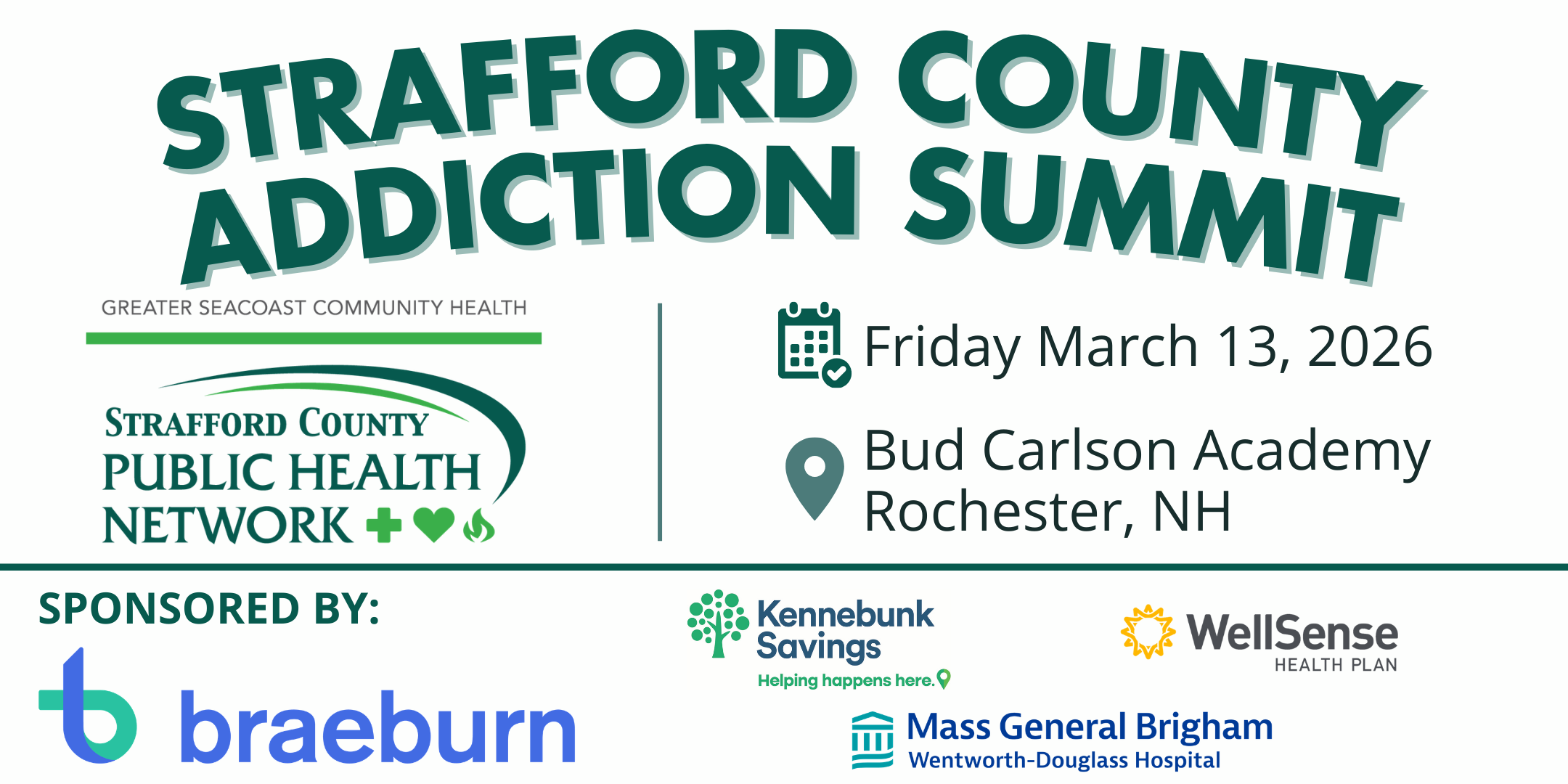
Each year, the Strafford County Addiction Task Force hosts the Addiction Summit to bring information about evidence-based programs, best-practices and innovative solutions to challenges in our communities related to the prevention, treatment, recovery and reduction of harm from substance use and mental health. This annual conference provides an opportunity for those working across sectors of the community to build their knowledge and skills in these topic areas.
Our Program:
-
-
- 8am – Registration & Continental Breakfast
- 8:45am – Opening Remarks
- 9 – 10am – Keynote Speaker: Tym Rourke, Third Horizon Strategies
- 10:15 – 11:30am – Workshop #1
- 11:30am – 12:30pm – Lunch
- 12:30 – 1:45pm – Workshop #2
- 2 – 3:15pm – Workshop #3
- 3:15 – 4pm – Networking & Evaluation
-
Download a copy of the full Summit Program here
Continuing education credits
We are currently applying for CEUs from the following professional licensing agencies:
-
-
- NH Prevention Certification Board for Certified Prevention Specialists (CPS)
- American Association for Marriage and Family Therapy for Licensed Marriage and Family Therapists (LMFT)
-
Learning Objectives:
We hope those who attend our Summit leave with:
- an increased knowledge and understanding of evidence based, evidence informed or best-practice strategies and activities that drive positive change related to topics across the continuum of substance use and mental health.
- the ability to apply new knowledge and skills related to prevention, treatment, recovery and harm reduction of substance use and mental health to their professional and personal practices.
- an understanding of how the intersection of work happening in the community and improved collaboration and coordination across sectors can build a stronger, more resilient and supportive community to reduce substance use, mental health and related challenges
2026 WORKSHOPS
Presenters: Kendra Lewis, UNH Extension and Suzanne Weete, Community Partners
A.I.D. “is a health education program aimed at equipping everyday people with the knowledge, understanding and skills needed to be active champions for mental health.”
This training was created and piloted by researchers from Kent State college of Public Health and Center for Public Police and Health through a federal mental health awareness training grant funded by the substance abuse and Mental Health administration of the United States Department of Health and Human Services, and is evidence based.
Recognizing and discussing mental health has become less stigmatized than in the past, but suicide and mental health struggles continue to be a world-wide crisis. To address and mitigate this issue, all members of our community need to learn how to recognize when someone is struggling with their mental health, how to speak with them about it, and how to direct them to appropriate help. This training is like others that address this issue such as Mental Health First Aid but is presented in 60-90 minutes compared to several hours, and can be taught to anyone, making it far more accessible than other training courses on this topic.
When everyone in our community, regardless of age or profession, has this knowledge, it helps break down stigma, reassures people that they are not alone, and can save lives by reducing suicide attempts and deaths.
Learning Objectives: Learners will leave the presentation with an understanding of basic mental health terminology, how to look for signs that someone may be experiencing a mental health crisis, how to approach them and what to do/not do, and how to help them identify appropriate resources and coping strategies.
Target Audiences: Any community member or professional wishing to learn how to recognize and aid someone in mental distress.
Presented by: Maggie Weaver, SOS Recovery Community Organization
In this workshop, we will discuss how SSPs can serve as a bridge for people who use drugs to access quality, dignified medical care and treatment. Together we will analyze the stigma people who use drugs too often face in medical settings, discuss strategies for advocacy and community collaboration, and learn why SSPs can have such an impact in changing the way we as providers collaborate. Using a pilot HCV testing and treatment model conducted by SOS Recovery, NH DHHS, and Lamprey Health Center, attendees will learn strategies to develop programming within their own SSPs to reduce barriers to testing and treatment, build working relationships with community providers, and empower people who use drugs as the leaders of their care. We hope to provide insight into the work happening in New Hampshire care coordination and engage in collaborative conversations about what is taking place nationwide so attendees can walk away feeling ready to push the status quo of how people who use drugs receive care in their own communities.
Presented by: Deryn Ayres, MPH, ACPS, CHW, Senior Population Health Coordinator with Dartmouth Hitchcock Medical Center, Maggie Coleman, MPH, Senior Population Health Coordinator with Dartmouth Hitchcock Medical Center and Jane Bradley Population Health Coordinator with Dartmouth Hitchcock Medical Center
Youth vaping has quickly become a significant public health concern, fueled by sleek
devices, attractive flavors, and marketing that makes nicotine use seem harmless.
Despite this, vaping carries serious risks for young people: nicotine can disrupt brain
development, heighten anxiety and depression, impair attention and learning, and
increase vulnerability to future addiction. Many youth become dependent faster than
expected due to high nicotine levels in vape products, often experiencing withdrawal,
irritability, and difficulty quitting even when motivated to stop. Preventing youth vaping is essential because early intervention protects developing brains, reduces long-term health risks, and helps young people build healthy coping skills before addiction takes hold. By staying informed and supportive, adults can play a powerful role in guiding youth toward safer, healthier choices.
This training will cover what vaping is, the devices and substances youth are using,
current trends driving its popularity, and the developmental risks associated with
nicotine and THC products. Participants will also explore local and national resources,
evidence-based prevention strategies, and practical ways to support youth through
education, open communication, and early intervention. The goal is to build adults’
knowledge and confidence so they can help young people make informed decisions in a vape-saturated environment.
This information can make a meaningful impact in the community by strengthening
adults’ ability to recognize, prevent, and respond to youth vaping. When caregivers,
educators, and community leaders understand the risks and available supports, they can have more effective conversations, identify early signs of use, and connect youth with help when needed. Shared awareness across homes, schools, and organizations fosters consistent messaging and a coordinated prevention effort. Over time, this leads to healthier coping skills, reduced vaping initiation, and a community culture that
prioritizes youth well-being. Ultimately, informed adults help create environments
where young people feel supported, understood, and empowered to make healthy
choices.
Learning Objectives:
- Understand the current trends around youth vape use in New Hampshire, what a
vape is and what’s in it, how vape devices can negatively impact youth development. - Learn about free campaigns, educational materials, and curriculums that you can
use around youth vape prevention, treatment, harm reduction, and recovery.
Target Audiences: Educators, parents, general community, youth-serving organizations,
Regional Public Health Networks, etc.
Presented by: Deirdre Colburn, Research Scientist, Crimes against Children Research Center, University of New Hampshire and Kimberly Mitchell, Research Professor, Crimes against Children Research Center, University of New Hampshire
Learning Objectives:
• Understand connection between risk and protective factors for youth (exposure to substance using caregivers and resiliency, for example) and their impact on mental health and substance use challenges
• Examine relationship between other co-occurring childhood adversities (i.e. abuse, neglect) and growing up in a household with a substance using caregiver
• Examine how social determinants of health (SDoH) are associated with childhood exposure to substance use, adversities, and current adult health outcomes
Target Audience: Teachers, law enforcement, clinicians, prevention professionals
Background:
Caregiver drug and alcohol use is a significant predictor of adverse child outcomes, like child abuse and neglect, substance-related problems, and mental health disorder. Indeed, in 2023, almost 19 million children were estimated to be living with a caregiver with substance use disorder and 6.1 million lived with parents with comorbid substance use disorder and mental illness. Given the severity of the opioid epidemic with 68% of the 2024 drug overdose deaths attributed to opioids, there is a worrisome lack of new research on the impact on children with family members who struggle with drugs and alcohol. We know that parental substance use is related to increased risk for child abuse and neglect, adolescent alcohol and drug use, and adverse effects on parenting and the provision of a nurturing environment. It is urgent that we identify new strategies to enhance the response to these drug endangered children (DEC).
Methods:
This presentation uses data collected for the Growing Up with Opioids (GrowingOp) Study. Data were collected between March 24, 2025 – July 23, 2025 online through Qualtrics survey platform. Individuals were recruited through ads on Facebook and Instagram. Participants were adults aged 18 to 60 residing in the United States. Our final sample included 1,571 participants. Survey questions asked individuals to reflect on the time in their life before turning 18. Topics included family drug and alcohol use details, childhood victimization and adversities, social determinants of health (SDoH), resiliency measures, help-seeking, and current mental health and personal substance use behaviors. The survey was created in partnership with the National Alliance for Drug Endangered Children (NADEC).
Results:
Over one-third (37%) of our sample reported growing up in a household where someone used substances – primarily a mother (40%) or father (57%). Alcohol (83.4%) was the most commonly cited substance, followed by marijuana (33%) and prescription pill misuse (19%). Individuals reported first learning about this person’s substance use in a variety of ways, including witnessing substance use or being told about it. They were most commonly (44%) under the age of 10 when they first found out about these substance use problems. Participants reported trying to help the person with substance use problems in a variety of ways such as driving them to AA meetings, being their support person, or calling the police. Those who grew up drug-endangered reported high rates (79%) of child neglect, sexual victimization (38%), physical abuse (81%), and emotional abuse (91%). They also reported significantly higher rates of suicidal thoughts and attempts – and higher rates of seeking help for concerns such as mental health or food and housing needs – than their non-DEC peers.
Conclusion:
Children who grow up in a household with a person with substance use problems face higher rates of co-occurring childhood adversities, neglect, abuse, and mental health concerns. But, they also seek help for these concerns at higher rates, suggesting there is opportunity to reach these youth for prevention and response efforts.
Presented by: Craig Jackson, Author, “Beyond the Lies: Addiction is much more than drinking alcohol or using drugs”
Description: Substance Use Disorder (SUD) creates powerful physical, mental and emotional cravings that change a user’s behavior and their relationships. Treatment models mainly focus on helping the addict accept their disease and recover, but friends and family are often unseen collateral damage—and they need help too.
Long-term exposure to addiction driven behavior causes loved ones to doubt their perceptions, disconnects them from their intuition, and adapt to instability as normal. Over time, this erosion of mental and emotional health manifests in a wide range of common symptoms such as anxiety, hypervigilance, shame, depression and anger. The ultimate outcome is a diminished sense of safety and well-being. This is why addiction has been called a “family disease”.
This workshop explores lesser discussed traits of SUD and how they contribute to unhealthy relationship dynamics. Through real-life examples and practical exercises, caregivers will learn how addiction-driven behaviors show up, and how families unknowingly play into them. treatment professionals will gain tools to help families and friends:
- Minimize emotional and mental injury
- Disengage from addiction-driven relationship patterns
- Recognize and stop unintentional enabling
- Reconnect with their own clarity, boundaries and sense of self
Workshop participants will leave equipped to shape family support groups which foster a better understanding of how the addicted mind works. They will be enabled to guide loved ones toward healthier, more grounded relationships even when active addiction is still present.
Presented by: Sheena Bice, DMSc, LCMHC, MLADC, CCTP, Head of Veteran and First Responder Services, Forge VFR, Owner, Shield and Compass Counseling and Consulting, PLLC
Description
Women veterans represent one of the fastest growing segments of the veteran population, yet they remain significantly underserved in substance use prevention, treatment, and recovery systems. National data consistently demonstrates that women veterans experience higher rates of military sexual trauma (MST), intimate partner violence, depression, and PTSD than their male counterparts, all of which are strongly associated with increased risk for substance use disorders (SUD). Despite this, women veterans are less likely to be accurately identified, referred, or retained in SUD services due to misidentification, stigma, fragmented systems of care, and limited availability of veteran-informed programming.
This workshop examines substance use disorders among women veterans through a trauma-informed and veteran-centered lens, connecting clinical realities to community-level solutions. Participants will explore how factors such as military culture, trauma exposure, caregiving roles, and social determinants of health shape substance use vulnerability, treatment engagement, and recovery outcomes for women veterans.
The session will begin with an overview of the scope of the issue, including epidemiological trends, common pathways into substance use, and the barriers women veterans face in accessing care particularly in rural and mixed civilian-military communities such as regions of New Hampshire.
Building from this foundation, the workshop will introduce evidence-informed and emerging practices that demonstrate positive impact when implemented with women veterans, including trauma-informed care models, peer-based recovery supports, integrated harm reduction approaches for alcohol, opioids, and polysubstance use, and community-based outreach strategies that improve identification and engagement.
Participants will engage in a brief case-based small group activity using real-world scenarios drawn from community practice. The session will conclude with practical tools and transferable strategies participants can implement in their organizations.
Learning Objectives
- Identify at least three population-specific risk factors contributing to substance use disorders among women veterans.
- Apply two trauma-informed and veteran-centered strategies for engaging women veterans in SUD prevention, treatment, or recovery services.
- Describe one community-level intervention that can improve access and outcomes for women veterans with SUD in New Hampshire.
Target Audiences
- Behavioral health and SUD providers
- First responders and law enforcement
- Peer recovery specialists
- Public health professionals
- Educators and school-based clinicians
- Community health workers
- Veteran service organizations
- Policy and advocacy professionals
- Anyone working across the continuum of care
Presenters:
Jessica Sherkanowski, CRSW, MERIT Program Case Manager and Recovery Housing Operator, Harbor Care; Elizabeth Cox, LCMHC, Director of Behavioral Health Services, Harbor Care
Abstract: The MERIT Program represents a statewide, evidence-based approach to reducing methamphetamine and stimulant use disorders (MSUDs) among New Hampshire’s most vulnerable adults. Operated by Harbor Care, MERIT focuses on individuals who are homeless, at imminent risk of harm, or experiencing polysubstance use, co-occurring mental health conditions, and complex medical needs. Through partnerships with residential and outpatient treatment programs, Federally Qualified Health Centers, and the statewide network of Recovery Community Centers, MERIT will serve 165 adults over a three-year period.
The program integrates primary care, behavioral health, psychiatry, oral health, residential and outpatient SUD treatment, recovery housing, and long-term recovery supports into a unified care model aligned with the SAMHSA/HRSA Level VI Integrated Care platform. Universal screening across 25+ service access points ensures that those with the highest risk are rapidly identified and engaged. MERIT strengthens recovery pathways by addressing whole-person wellness and the social determinants of health that influence long-term outcomes. This presentation will highlight the program’s design, partnerships, implementation strategies, and anticipated community impact, demonstrating how integrated care can transform recovery for high-need populations.
Learning Objectives:
By the end of this session, participants will be able to:
1. Describe the core components of the MERIT Program and its statewide integrated treatment model for methamphetamine and stimulant use disorders (MSUDs).
2. Identify at least three risk factors and barriers faced by adults experiencing homelessness, polysubstance use, or co-occurring disorders that contribute to high-risk stimulant use.
3. Explain how Level VI SAMHSA/HRSA Integrated Care principles can be applied to coordinate medical, behavioral health, oral health, and recovery support services.
4. Recognize the role of universal screening and cross-sector partnerships in improving rapid engagement for high-need individuals.
5. Assess how integrated care and recovery-oriented systems of support can reduce harm, improve treatment outcomes, and strengthen community recovery infrastructure.
Target Audiences
This presentation is designed for a broad range of professionals and stakeholders, including:
• Behavioral health providers (SUD clinicians, mental health clinicians, psychiatrists)
• Primary care & oral health providers
• Recovery support professionals and peer recovery coaches
• Homeless service providers and housing specialists
• Emergency department staff & first responders
• Case managers and care coordinators
• Social workers and public health professionals
• Administrators and policy leaders in health, human services, and community organizations
• Educators working with at-risk populations
• Community partners, including FQHCs, RCCs, and treatment programs
• Anyone interested in integrated care models, stimulant use trends, and best practices in recovery-oriented systems of care
description coming soon!
Presented by: Mark Lefebvre, Author of Healing a Village: A Practical Guide to Building Recovery Ready Communities, Recovery Ready Community Consultant
Many people living with mental health conditions and/or substance use disorders who are reentering the community face challenges accessing treatment and services (e.g., health care, medication), as well as housing, employment, food, and social supports, Releasing individuals into the community without ensuring access to these basic needs increases their risk for future justice system involvement and/or recurrence of substance use.
Barriers to these essential services include stigma, criminal record, lack of access to required records, and lack of transportation. Effective aftercare planning for individuals with justice involvement must ensure the community offers sufficient recovery capital to meet these basic needs.
This workshop provides a detailed blueprint for a community coalition approach to raising recovery capital and ultimately to provide the best possible outcomes for individuals re-entering the community following incarceration.
Learning Objectives:
1. Attendees will learn about the needs of individuals re-entering communities and the role of communities to meet these needs.
2. Attendees will learn about barriers facing individuals re-entering from judicial systems.
3. Attendees will learn about the role of recovery-ready communities in meeting these needs.
Target Audiences: Community leaders, business community, healthcare providers, housing advocates, justice system professionals.
Presenters
Josh Colwell (Moderator), Laura Wargo, John Iudice, & Geoff Booker
Learning Objectives
By the end of this presentation, participants will be able to:
- Identify key challenges and ethical considerations related to the recurrence of drugs or alcohol in work, treatment and recovery housing settings.
- Describe recovery-oriented, trauma-informed, and harm-reduction approaches used to respond to recurrence while maintaining safety and accountability.
- Apply insights from the panel to inform or strengthen policies, practices, and collaborative responses within their own organizations and communities.
Target Audiences
People who own or manage businesses, Treatment Centers, and/or Recovery Housing
Introduction / Short Description of the Presentation
This presentation will feature a moderated panel of professionals working across treatment, recovery housing, and employment spaces. Panelists will share their professional insight and lived experience-informed perspectives on how to respond when drugs or alcohol reappear in recovery-oriented environments. The discussion will be guided by prepared questions from the moderator, with time for audience questions if available. The goal is to create an open, honest, and practical conversation about a complex and often uncomfortable topic that impacts recovery communities at all levels.
Background of the Problem and Potential Intervention, Program, or Policy
The recurrence of substance use in work, treatment and recovery housing settings is a common reality that presents significant challenges for employers, providers, staff, and residents. Organizations are often tasked with balancing safety, accountability, ethical responsibility, and recovery-oriented values when substance use occurs. Responses vary widely and may include immediate discharge, increased supervision, referral to higher levels of care, or supportive interventions. In many cases, inconsistent policies, limited staff training, and stigma surrounding recurrence contribute to reactive or punitive responses that may unintentionally disrupt recovery.
This panel will examine existing practices and policies used to address recurrence, including recovery-oriented, trauma-informed, and harm-reduction approaches. Panelists will discuss decision-making frameworks, policy development, and intervention strategies that support both individual recovery and community safety. The conversation will highlight the importance of clear policies, staff preparedness, and collaborative responses between treatment providers and recovery housing programs.
Impact of Implementation on Communities
Implementing thoughtful, consistent, and recovery-oriented responses to recurrence can positively impact individuals, organizations, and the broader community. Effective practices can reduce unnecessary discharges, promote continuity of care, and maintain safer and more supportive recovery environments. When organizations adopt clear policies and evidence-informed interventions, staff are better equipped to respond confidently and ethically, and residents experience greater transparency and trust.
At the community level, these approaches support stronger collaboration between treatment providers, recovery housing, and recovery support services, leading to improved outcomes and reduced strain on emergency and crisis systems. By normalizing honest conversations about recurrence and sharing practical strategies, this presentation aims to strengthen recovery ecosystems and promote healthier, more resilient communities
THANK YOU TO THIS YEARS' SPONSORS
Public Health Champion Sponsor: